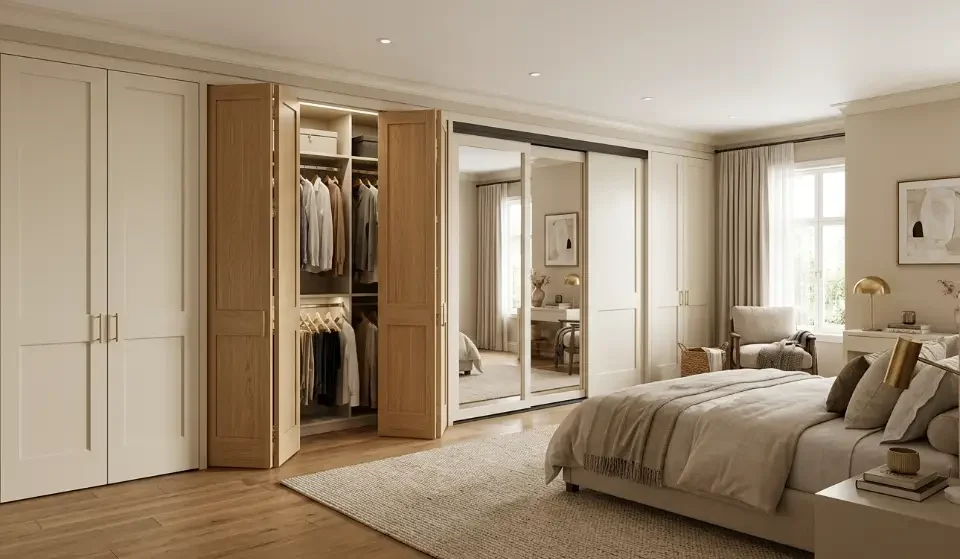

The wrong closet door can make a room feel smaller, block furniture, and waste valuable floor space. With so many types of closet doors available, it’s easy to choose one that looks great but doesn’t work well in your room. Some doors need plenty of swing space, while others slide or fold to save room. Your closet size, layout, furniture, and the amount of access you need all matter before making a choice. In this guide, we’ll look at 11 popular closet door styles, from bifold and sliding doors to barn, mirrored, and glass options. You’ll also learn how each option affects space, access, privacy, and everyday use.
11 Types of Closet Doors for Any Room

1. Bifold Closet Doors
Bifold doors fold toward the sides instead of swinging across the room. That makes them practical for standard reach-in closets where you want good access without using too much floor space.
They work especially well when furniture sits near the closet. A dresser, for example, may block a traditional hinged door. Bifolds reduce that problem. Just measure the opening before buying because the folded panels still take up some space inside the opening.
2. Sliding Bypass Closet Doors
Sliding bypass doors move along a track, with one panel passing behind another. Since they don’t swing outward, they’re useful in bedrooms where floor space is limited.
The main trade-off is access. One panel normally overlaps the other, so you can’t see the entire closet at once. They’re a good fit when you usually reach into one side at a time.
3. Barn Closet Doors
Barn doors add a strong decorative feature while sliding along a track mounted above the opening. They’re popular in rustic, farmhouse, industrial, and modern rooms.
However, they need clear wall space beside the closet. A window, outlet, or large dresser can stop the door from sliding fully open. Check the wall before choosing the style. Otherwise, that beautiful door can become a daily headache.
4. Hinged Closet Doors
Hinged doors are the traditional option. They attach to the frame with hinges and swing open to provide direct access to the closet.
Their biggest drawback is the swing area. A nearby dresser or narrow walkway can get in the way. Before installation, check the door’s full swing and make sure nothing will block it.
5. French Closet Doors
French doors use two panels that meet in the center. They give wide closets an elegant look and provide excellent access when both doors are open.
They’re best suited to larger bedrooms or walk-in closets with enough floor clearance. In a small room, however, two swinging panels can create more problems than they solve. Bifold or sliding doors may use the available space better.
6. Pocket Closet Doors
Pocket doors slide into the wall when opened. This makes them one of the most space-saving closet doors because almost the entire door disappears.
There’s one important catch. The wall needs enough usable space for the door cavity. Electrical wiring, plumbing, or structural elements can make installation difficult. Pocket doors make the most sense during renovations when the wall can be inspected before installation.
7. Mirrored Closet Doors

Mirrored doors give you a full-length mirror while covering the closet. That’s especially useful in bedrooms because you don’t need another large mirror taking up wall space.
They can also reflect light and make a room feel more open. Still, think about what the mirror will reflect. A cluttered desk or crowded corner will become more noticeable across a large reflective door.
8. Louvered Closet Doors
Louvered doors have angled slats that allow air to move through the panels. They’re useful where ventilation matters, including some laundry or utility areas.
Their appearance also suits traditional and coastal rooms. However, they don’t offer the same visual privacy as solid panels. If ventilation isn’t important, a solid door may work better. For appliances, always follow the manufacturer’s ventilation requirements and local codes.
9. Accordion Closet Doors
Accordion doors contain several connected panels that fold together. They can cover wider openings while using little floor space.
They’re useful for awkward layouts where hinged doors aren’t practical. They’re also relatively simple when you don’t want major construction work. The downside is appearance. Some inexpensive models can look basic, so choose the material and hardware carefully if the closet is highly visible.
10. Glass Closet Doors
Glass doors create a clean and modern appearance. You can choose clear, frosted, textured, or decorative glass depending on how much privacy you want.
Clear glass works when you want the closet to become part of the room’s design. Frosted glass gives you more privacy while keeping the modern feel. Remember that glass puts your closet contents on display, so organization becomes part of the overall look.
11. Curtain Closet Doors
Curtains are the simplest and cheapest option. They don’t need a swinging area and can cover a closet opening without complicated construction.
They’re especially useful in rentals, temporary spaces, or very small bedrooms. The main limitation is appearance and privacy. Curtains work well when flexibility and low cost matter more than a built-in finish.
How to Choose the Right Types of Closet Doors

The best door isn’t necessarily the most expensive one. Start by looking at the space around your closet. Check the floor, nearby furniture, surrounding walls, and the direction the door needs to move.
For example, bypass doors save floor space because they slide. Barn doors do the same but need clear wall space. Pocket doors save even more visible space but may require construction inside the wall.
| Room situation | Door styles to consider | Why |
| Small bedroom | Bifold, bypass, pocket | Saves floor space |
| Wide closet | Bifold, French | Gives broad access |
| Rustic room | Barn, hinged | Adds character |
| Modern bedroom | Glass, mirrored | Clean appearance |
| Utility area | Louvered, hinged | Practical access |
| Rental | Curtain, accordion | Easy to change |
| Walk-in closet | Hinged, French, pocket | Good access |
Think About the Closet Opening
Your opening size plays a major role in choosing closet door styles. A narrow opening may work well with bifold panels. A wide opening may suit French or multiple sliding panels.
Don’t measure only the old door. Measure the finished opening, height, width, trim, nearby walls, and floor area. Also check your furniture. A door can fit perfectly and still be wrong for the room.
Compare Space, Access, and Privacy
Every design has a trade-off. Sliding doors save floor space but overlap. Hinged doors give full access but need swing clearance. Glass looks modern but offers less privacy.
| Door type | Floor space | Access | Privacy | Main issue |
| Bifold | Low | High | High | Folding panels |
| Bypass | Very low | Medium | High | Panels overlap |
| Barn | Very low | High | Medium | Needs wall space |
| Hinged | High | High | High | Needs swing area |
| French | High | High | High | Needs floor space |
| Very low | High | High | Harder installation | |
| Mirrored | Depends | Depends | High | Shows reflections |
| Louvered | Depends | High | Medium | Less privacy |
| Accordion | Low | High | Medium | Can look basic |
| Glass | Depends | High | Low-medium | Shows contents |
| Curtain | Very low | High | Medium | Less built-in look |
A simple rule helps here: choose the door movement first, then choose the appearance. Once you know whether the door should swing, slide, fold, or disappear into the wall, the design choice becomes much easier.
For more home and decorating ideas, you can also explore HomeEvery and find inspiration for other areas of your home.
Measure Before Buying
Measurement can make or break a closet project. Start with the finished opening rather than guessing from the old door. Measure the width at several points because older openings may not be perfectly square.
Then measure the height and check the floor below the opening. Look at the wall beside it too. Barn doors need sliding space. Pocket doors need room inside the wall. Hinged doors need room to swing.
| What to measure | Why it matters |
| Opening width | Determines door size |
| Opening height | Helps match the panels |
| Wall beside opening | Needed for sliding doors |
| Floor clearance | Needed for swinging doors |
| Nearby furniture | Prevents collisions |
| Trim | Affects fitting |
| Wall depth | Important for pocket doors |
Take your measurements twice before ordering. This small step can prevent an expensive return or installation problem.
If you’re planning a wider home makeover, HomeEvery also offers ideas that can help you think about the overall look and function of your space rather than treating the closet as a separate feature.
Common Closet Door Mistakes to Avoid
One common mistake is choosing a door only because it looks attractive. A barn door won’t work well if a dresser blocks the wall beside it. French doors can also become frustrating when the room has a narrow walkway.
Another mistake is ignoring the hardware. Tracks, rollers, hinges, and anchors need to support the door correctly. Poor hardware can make even an expensive door feel cheap.
Before installation, test the door movement. Imagine where every panel will go when fully open. This matters more than how the door looks when it’s closed.
For residential door selection, the U.S. Department of Energy also recommends considering factors such as durability, air leakage, and installation when evaluating door products. U.S. Department of Energy is a useful reference for broader door considerations.
Closet Door Types Compared at a Glance
This final comparison makes the choice easier when you already know your room’s limitations.
| Style | Best for | Biggest advantage | Main limitation |
| Bifold | Reach-in closets | Good access | Panels fold inward |
| Bypass | Small bedrooms | Saves floor space | Overlapping panels |
| Barn | Rustic rooms | Strong style | Needs wall clearance |
| Hinged | Traditional rooms | Simple and accessible | Needs swing space |
| French | Wide openings | Elegant access | Needs floor space |
| Renovations | Disappears into wall | Complex installation | |
| Mirrored | Bedrooms | Door plus mirror | Reflects clutter |
| Louvered | Utility areas | Air movement | Less privacy |
| Accordion | Awkward openings | Flexible folding | Some look basic |
| Glass | Modern rooms | Open appearance | Less privacy |
| Curtain | Rentals | Low cost | Less built-in look |
Which Closet Door Type Should You Choose?

For a small bedroom, start with bifold, bypass, or pocket doors. They can reduce the amount of floor space needed. For a wide opening, French or bifold doors may provide better access.
Modern rooms can work well with glass or mirrored doors. Barn doors suit spaces where the wall beside the closet is clear. Meanwhile, curtains and accordion doors make sense when cost and flexibility matter most.
The right choice comes down to space, access, function, and style. Measure first. Check furniture clearance next. Then choose the finish that fits your room.
Frequently Asked Questions About Closet Door Types
What are the most popular types of closet doors?
Bifold, sliding bypass, hinged, barn, mirrored, and pocket doors are common choices. Your available space and required closet access should guide the decision.
Which closet doors save the most space?
Pocket, bypass, bifold, and accordion doors generally use less floor space than hinged doors. Pocket doors require suitable wall construction.
Are bifold or sliding closet doors better?
They solve different problems. Bifold doors can provide wider access, while sliding doors usually need less floor clearance.
What closet doors work best for a small bedroom?
Bypass, bifold, and pocket doors are practical choices for smaller rooms. They reduce the space needed for a swinging door.
How do I measure for closet doors?
Measure the finished opening’s width and height. Then check nearby furniture, wall clearance, trim, and the space needed for the door hardware.
Final Thoughts
The right closet door can change how a room feels and functions. It can free floor space, improve access, add a mirror, or become a strong design feature.
Before buying, measure your opening and check the furniture around it. Then decide how much access you need and how the door should move. Once those details are clear, choosing between the different types of closet doors becomes much easier.
Start with your measurements. Then use the comparison tables above to narrow your choices to the styles that actually fit your room.


